Fredericksburg's Candlelight Tour Is About One Builder This Year. You've Walked Past His Work for Decades.
November 12, 2026
November 12, 2026
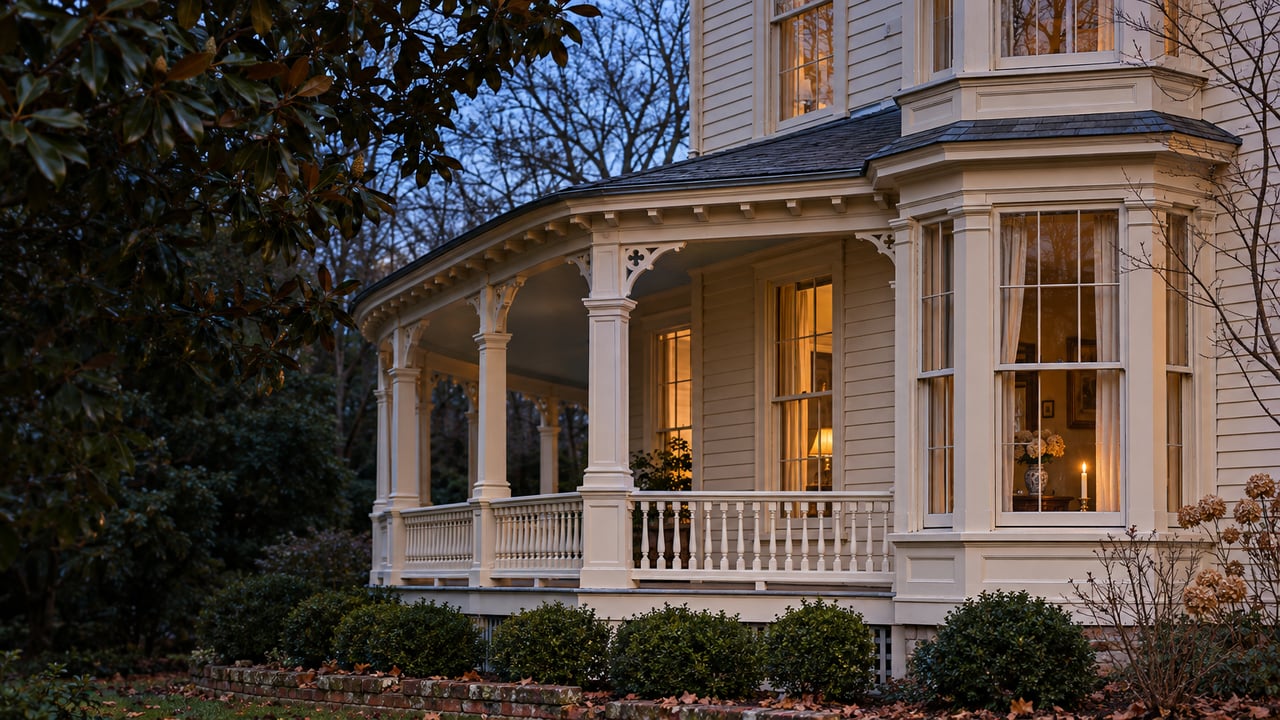
Fredericksburg markets itself on the 1700s. The houses on this year's Candlelight Tour were built later. One went up in 1916 and another in 1925, and the same man had a hand in building both.
The Historic Fredericksburg Foundation's 56th Annual Candlelight Tour, on December 12 and 13, is organized around Elmer Grimsley "Peck" Heflin. The foundation's tour page puts the question plainly: if you have admired one of the city's distinctive early-20th-century homes or historic commercial buildings, chances are you've seen his work. On Washington Avenue, on downtown street corners and on the old Kenmore grounds, his work is easy to find once you have his name.
Heflin was born in Fredericksburg on February 22, 1877, and died on July 13, 1941. According to his obituary in The Free Lance-Star, transcribed on Find a Grave, he left school at 15 to work as a carpenter, was a contracting builder by 18, and studied architecture through a correspondence course while he kept working. The same obituary describes him as a longtime City Council member, businessman, contractor, architect and hotel owner.
The size of his career is the striking part. The obituary credits him with more than twenty important commercial, industrial, educational and residential buildings in town, and says he could not remember how many private houses he had built. In 1932 he built the Stratford Hotel. HFFI's summary of his career is short: a self-taught designer and master builder whose homes and commercial buildings "helped shape the character of Fredericksburg."
The easiest place to see his range is one street. The Central Rappahannock Regional Library's history of Washington Avenue and a Free Lance-Star feature on an earlier Candlelight Tour connect four houses there to Heflin, built over roughly twelve years.
| Address | Year | Heflin's role | Style and material |
|---|---|---|---|
| 1311 Washington Ave. | 1904 | Builder | Elaborate Queen Anne and Colonial blend |
| 1206 Washington Ave. | 1906 | Architect and builder | Local granite, Chateau Victorian |
| 1305 Washington Ave. | c. 1909 | Builder | Queen Anne and Colonial Revival |
| 1200 Washington Ave. | 1916 | Builder, to Philip Stern's design | Prairie style with Arts and Crafts details |
Even if you've never heard of Heflin, you have probably noticed 1206. He built it for E.J. Cartwright, a local businessman, out of stone from the Battlefield Granite Company on the Rappahannock River, which Cartwright and a partner had bought in 1900. The Free Lance-Star reported that Cartwright hoped the house would become a prototype for other city homes, though the idea never caught on. The gargoyle on the porch roof came much later. A previous owner added it in the 1990s, which is how the place became known as the Gargoyle House.
The table also shows his style changing. In the first decade of the 1900s he was working in Queen Anne and Colonial blends. By 1916 he was building a dark red brick house with a green mission tile hipped roof, exposed rafter tails and triangular knee braces under the entry hood. That's 1200 Washington Avenue, which Victor Moon commissioned from Heflin to a Prairie-style design by architect Philip Nathaniel Stern. This year it's the Saturday evening stop on the tour.
Stern and Heflin overlap in other places too. HFFI credits Stern with designing the 1908 Lafayette School, the building that now houses the Central Rappahannock Regional Library. Heflin's obituary includes Lafayette Elementary School on his list of works. Designing a building and constructing it were separate jobs, and Fredericksburg had a self-taught builder who could do both.
The same habit of building whatever the town needed shows up on Caroline Street. The library's history of downtown hotels says Heflin built the brick Enterprise Building at Caroline and Hanover streets around 1900, on the site of the former Farmers' Hotel. The ground floor held a store and the post office. The upper floors held a public hall, apartments and offices.
His obituary reads like a list of the businesses that ran early-20th-century downtown: the Commercial State Bank, the Farmers & Merchants State Bank, the Law Building, the Princess Anne Hotel, the first Mary Washington Hospital, Woolworth, J.C. Penney, E.M. Curtis, Montgomery Ward, Jones Motor Co., the Colonial Theater, and the Knoxanna, Heflin and Wakefield apartments. It also credits him with a Mary Washington College dormitory and classroom building and with the first unit of James Monroe High School. A town of Fredericksburg's size needs banks, a theater, a hospital, apartments and schools, and for a stretch of years a large share of them came from one contractor.
The 1890 Shiloh Baptist Church (Old Site) at 801 Sophia Street is a Heflin building, but not one of Peck's. The church's own history credits its construction to C.G. Heflin, Peck's older brother.
Heflin's later work goes beyond single buildings. In 1914 the Howard family, the last private residents of Kenmore, sold the property to Heflin, whom the Kenmore organization calls a prolific land developer. He had divided it into lots by the end of that year. A 1921 newspaper ad showed his plan for "Kenmore Court," with the old Kenmore residence at the center, roughly twenty lots around it, and driveways designed so cars could reach the whole block. The first houses went up on the 1200 block of Winchester Street.
HFFI's College Terrace neighborhood history lists Heflin among the builders working in that subdivision near the University of Mary Washington, which was platted in 1917. The history also records a separate Heflin-Whitbeck subdivision there, dated 1931 to 1934. The neighborhood's styles run from Classical Revival and Colonial Revival to Folk Victorian, American Foursquare and Craftsman bungalow, which are the same forms that fill much of early-20th-century Fredericksburg.
The tour homes come from this later period. The Free Lance-Star has identified 706 Cornell Street as a house Heflin built in 1925. The full 2026 lineup on the FXBG event listing is 706 Cornell St., 800 Cornell St., 810 Sylvania Ave., 904 Sylvania Ave. and 808 Prince Edward St., with 1200 Washington Avenue added for Saturday evening ticket holders.
The tour runs Saturday, December 12, from 11 a.m. to 4 p.m. and Sunday, December 13, from noon to 4 p.m. Check-in is at Memorial Park, 1401 Kenmore Avenue. Tickets went on sale November 1. Regular admission is $40, and the Saturday evening VIP add-on is $35. HFFI says proceeds support its work to preserve, protect and promote the city's historic built environment.
Saturday is the busier of the two days downtown. Here is how the day lines up:
If the cookie crawl is on your list, keep in mind that the daytime tour closes at 4 p.m., an hour after the crawl opens.
The Riverfront Park skating rink adds one more option for the evening. It opens November 27 and runs through January 3, 2027. Admission is $12 for ages 13 and up and $8 for ages 12 and under, skates included, with timed tickets.
You don't need a ticket to see Heflin's work. The four Washington Avenue houses in the table are on one street, 1206 is hard to miss, and the Enterprise Building is at Caroline and Hanover. The ticket gets you inside, and Sunday's hours give you a second day if Saturday fills up.
If you own an early-20th-century Fredericksburg home and have wondered who built it and what it's worth today, Cheantae Lewis can help you put a current value on that history. Get your free home valuation.
Stay up to date on the latest real estate trends.
Reach out to Cheantae Lewis for expert real estate services. Buy, sell, or rent properties with confidence. Contact her today!